
Lessons In Energetics: Chapter Twenty-Six
Unavoidable and Totally Basic Shadows

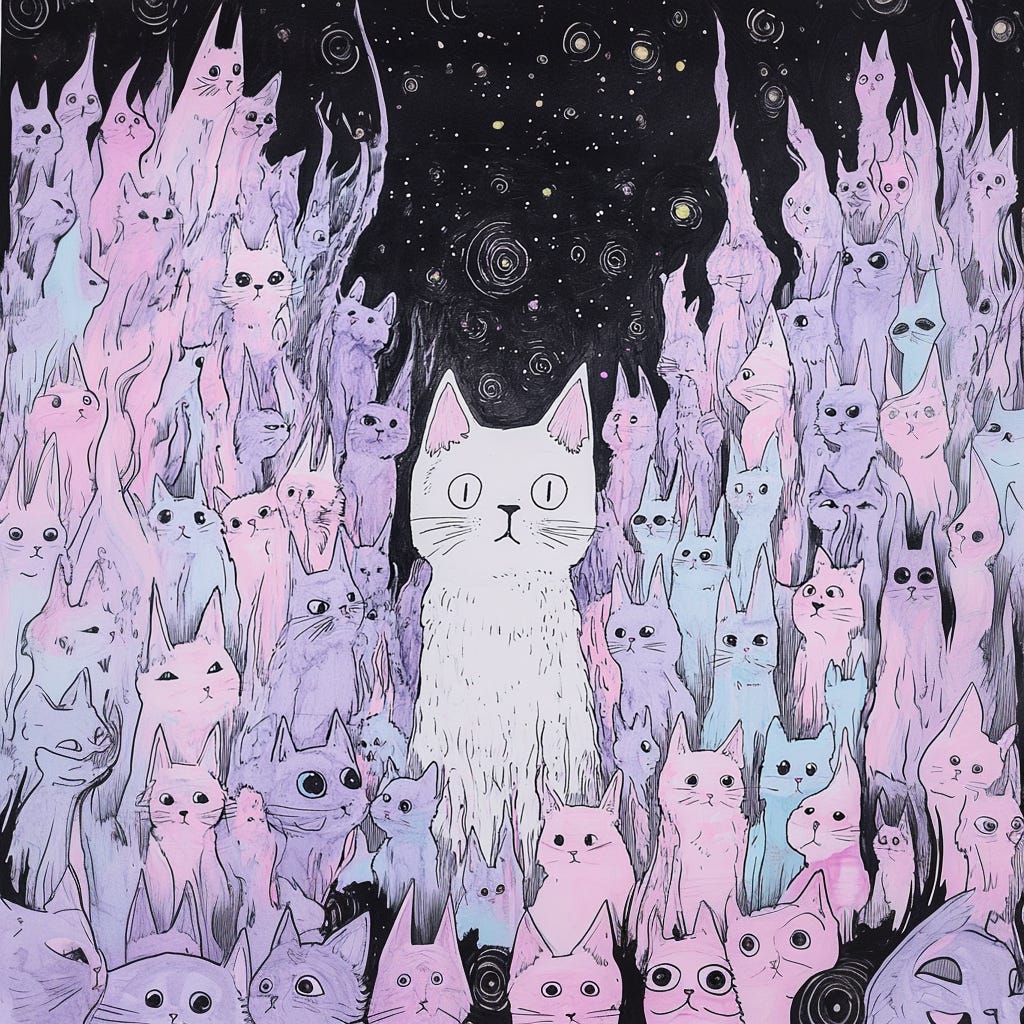
As I continued to look within, the person I was becoming grew more and more unfamiliar to those around me. It’s a strange thing—to realize just how imprisoned you once felt in your own life, and then to suddenly feel free. That freedom is beautiful. To finally like the person staring back at you in the mirror—I'd never known that before.
I went from believing I was the problem, someone others merely tolerated, to recognizing and embracing the beautiful qualities within me. I even began to entertain the idea that maybe, just maybe, I could make a difference in the world. With each inner victory, the sense of expansion grew. It felt only natural to want to share that joy with someone.
Yet, even in that blossoming, I still felt alone.
There were times it felt like I was speaking into an empty room—my voice echoing with no one there to hear it. It was a bittersweet season. I felt like I was finally arriving, finally becoming myself… but somehow, that arrival left me deserted. Misunderstood. Alone on an island.
Life never really offered me many opportunities to learn how to build healthy relationships. I appreciated my husband. I knew how to make a client happy. I could impress others with my talents. But sustaining a relationship with someone who simply liked me—for me—was always hard.
In my early childhood, most relationships ended with someone telling me I was “too much.” Later, when our family became more involved in church during my teenage years, I hoped maybe that would bring better chances for friendship. But, as I’ve shared before, that hope was difficult to hold at home. No one ever seemed good enough for my mother, and she had a way of keeping people isolated. Any relationship that managed to survive that environment would eventually end with a comment like, “You’re so up and down—it’s just too much.”
Eventually, I came to the conclusion that there must be something wrong with me. No matter how hard I tried, I just couldn’t seem to get it right.
In my twenties, I finally gathered enough courage to try making friends again. There was a girl at work who seemed kind, and I decided I was going to invite her to hang out. She had mentioned she had annual passes to a theme park—so did I—and I thought maybe that could be a good starting point.
Maybe for some people, being friendly and striking up conversations comes naturally. But for me, that day, my stomach was full of butterflies. My breath was short as I tried to summon the nerve to ask her to meet me at the park sometime.
I’m sure it’s not supposed to feel that hard—but it did.
She said yes!
She seemed comfortable with me just being myself. Like me, she was a foodie and loved theme parks. She was a bit more reserved—definitely not the type to make the first call or initiate plans—and she wasn’t nearly as impulsive as I was. She took her time making decisions, which was different from my usual pace. Still, she was always happy to go on adventures with me, and we ended up doing a lot together.
Over time, she became a significant person in that season of my life.
In the years that followed, I went on to make a few other friends. Never many—but those I did connect with got to see a different side of me. I’ve always been someone who’s all in, and willingly open when I feel safe.
It was around this point in my journey, I learned a profound lesson about energetics—and the importance of the relationships we hold in our lives. The lesson was this: everything is energy. Every interaction, every connection, is an energetic exchange.
We come into this life to grow, to evolve, to remember. And relationships are the sacred ingredients that catalyze that process.
As we heal—as we confront our shadows and raise our vibration—we begin to transform. That transformation inevitably shifts the energetic agreements we’ve held with others. The connection changes. The relationship itself begins to renegotiate, energetically speaking. It’s not always visible on the surface, but something fundamental shifts beneath it all.
It means the universe says, “Ah, you’ve chosen to heal and evolve. And so, those who were once aligned with your vibration—those who served a purpose at that level—must now either grow with you or move in a different direction.”
I don’t see this as anyone being better or more advanced than another. It’s simply an energetic re-evaluation—a natural check-in to see if each person’s path still aligns.
Relationships are sacred invitations. They call us to explore different aspects of ourselves and our lives. But once a relationship has served its purpose, a shift may become necessary—so that space can be made for new growth, new connections, new lessons.
So, what did this look like in my life?
It meant that everything began to feel like it was falling apart. All of the old energy—the structures, the roles, the identities I had once clung to—had to break away so my new reality could be built, brick by brick.
For those of you who read tarot, this was my Tower moment.
The Tower card shows a tall structure struck by lightning, engulfed in flames, with people tumbling from its heights. It’s the card of sudden upheaval, of truth crashing through illusion. And that’s exactly what it felt like. I had made the decision to commit to my healing—and now, the universe was holding me to it.
At the time, I didn’t understand what was happening. It just felt awful. Like the rug had been ripped out from beneath me.
The strange part was, I thought I was doing well. I was gaining confidence, having powerful realizations about myself. In many ways, I believed the worst was behind me. But I would come to learn that awakening isn't always gentle. Sometimes, it begins in the ashes.
One by one, I watched the relationships in my life come to a crossroads.
The first one to go was hard—probably because I hadn’t yet seen the pattern. I didn’t realize what was unfolding beneath the surface.
It was someone I had worked closely with for years. I had sensed that our professional path might shift, and I thought I had made peace with that. It even seemed like our friendship had withstood the adjustment. Or so I believed. In fact, I thought we were growing closer. She, too, was on a spiritual path, and in many ways, I felt like we truly understood one another.
One day, she invited me to a reflective circle she was hosting. At the time, I had been feeling especially lonely. Making new connections has never come easily to me, so I made a conscious decision that night to give myself permission to simply be myself—to relax, to soften, to enjoy. After all, wasn’t that the very thing I had been fighting for through this whole awakening process?
I thought how refreshing it would be to be among others who shared similar interests. And honestly, that evening was refreshing. I had a wonderful time. I listened to the stories of the other women, shared openly, and engaged in conversation with ease.
But just a few weeks later, she ended the relationship.
It hurt—deeply. Once again, I was told I was “too much.” She said it took her thirty days to recover from being in my presence.
Thirty days.
I scoffed at the absurdity of it. How could that even be possible?
But beneath the disbelief, my old wounds opened wide. My first response was to turn on myself. I fell into the spiral. How could someone who cares so deeply, who considers so much, still get it so wrong? I wondered. How could I love this fiercely and still be unlovable?
Where was I supposed to go to be just enough?
Where in this world would someone want someone like me?
For a while, I didn’t know the answer. I felt misplaced. Misunderstood. Even in my own home. I was becoming someone I was finally proud of—and yet it seemed no one wanted that version of me.
Flashbacks of childhood flooded in. I remembered how hard I had tried to please my parents, only to feel discarded. Like all my efforts had been in vain. All for what?!
I spiraled for a while.
But after about a week, I found my footing. I reached out for my shadow, I took my shadows hand, and invited her to dance the sacred dance of healing.
“What are you feeling?” I asked myself.
“I’m feeling WRONG, flawed, alone, misunderstood! How could she not see how much I cared?! How could I care so much, think so much, worry so much about getting it right, just to be told I’m too much! I thought I was safe! I thought I could relax and just give myself permission to BE! Yet, no one wants the me I’m trying to be! Why does this keep happening to me!”
How can you look at how you are feeling with more responsibility? “How can you provide yourself with what you need?" I replied to myself.
I began to examine both the good and the challenging moments of that relationship. I started to see that every relationship comes into our lives for a season, a reason—a vital ingredient in healing our karma. Like my husband, she had been there during times when I couldn’t be there for myself. She listened patiently as I sorted through my feelings, again and again, over the years. Often, I did the same for her.
Since I had learned that we are each responsible for our own feelings, I realized that between us, there were moments when we offered support—and moments when we unknowingly triggered each other. There were no absolutes, no right or wrong, no winners or losers. When we take responsibility for our feelings and understand that what we seek cannot be found in another but only within ourselves, we can begin to change the narrative.
Relationships aren’t a reflection of our worthiness or likability. They aren’t a scoreboard where staying means you’re good, leaving means you’re flawed, or walking away means the other person was at fault. This mindset sets us up for failure. Relationships exist to help us evolve and grow; they flow in and out of our lives like the tides.
Measuring our worth by whether a relationship lasts—or trying to make someone stay—places unfair pressure on both parties and defies the natural rhythm of growth. When we live striving to fulfill needs through others or keep someone pleased to fill a void in ourselves, we lose ourselves in a situation destined to change. We must allow ourselves—and others—the freedom to evolve.
This is often scary because human nature craves consistency and security. We want needs met and expect others to remain the same, to reliably fill that space.
I realized that just as I am responsible for my triggers, she is responsible for hers. There is no taking sides. Perhaps the universe brought us together for support, or maybe to provoke transformation. Either way, neither of us is greater or lesser—whether the relationship lasts or ends.
We were simply two players in the game of personal evolution. Maybe I was no longer the right fit in her eyes, or perhaps the purpose of our connection had been fulfilled, and now it was time for both of us to bloom in our own directions.
Seeing relationships this way allows more grace in how we view and heal from loss. Too often, people carry deep wounds, resentment, or rigid perspectives because they’ve tied their worth to lost connections.
I personally find comfort in the realizations I’ve shared. They create space for peace to settle. Some might relate to this through the word forgiveness, often linked with the idea of peace. Yet, reflecting more deeply on what I’ve experienced, I see that forgiveness isn’t quite the right word here. There’s really nothing to forgive in this scenario. A more accurate way to describe it is that I found peace—a state of mind that genuinely wished her well and much success.
Going through this was a necessary step—a building block that gave me the strength and clarity to face what came next. Just a little over a month later, I found myself feeling more rooted and at ease with what had happened. It was around then that the growing distance between my husband and me became undeniable. Conversation felt strained; we struggled to connect and found silence or frustration filling the spaces between us. Talking about astrology, Human Design, or spiritual topics overwhelmed him and held little interest.
I began to notice that, for most of our relationship, I had done most of the talking. This became a problem as my mind overflowed with new, exciting ideas that were beyond his understanding or curiosity. So we simply stopped talking. And even when we did talk, those conversations often revolved around him trying to support me. But as I grew more confident and capable of navigating my shadows alone, he began to worry—about where he fit in, if I still needed him. I was evolving into someone more balanced and self-sufficient.
Our relationship started feeling unfamiliar. The universe seemed to be urging us to build a stronger foundation, but in order to do that, the old one had to collapse. Then, one day, everything came rushing out—layers of hurt, unspoken fears, and hidden resentments poured forth. I heard things that once would have shattered me—words revealing his deepest fears and frustrations. Some of the hardest truths I’ve ever heard from someone I loved.
Everything was laid bare: his pain around my career struggles, our lack of similarity, our inability to relate to one another, and the realization that things weren’t as rosy as we had believed. Our differences in goals and needs—all those skeletons came out of the closet.
For two intense weeks, we talked through everything we could, until the emotional weight became too much to bear. Then, the next day, we would start again. We said things neither of us ever expected—like the real possibility that there might be no clear ending to our story. We entertained the idea that, in the end, we might not be together. Slowly, we began to speak more like friends, exploring what each of us truly needed. We committed to taking things one day at a time, even though we had no idea where it would lead.
It felt like a reintroduction—a fresh start of sorts. We shared the common fear that under different circumstances, neither of us would have chosen the other. Alongside that was the reality of the challenges life had thrown at us, and the dysfunction that had initially brought us together. Still, we took a moment to celebrate what this process had taught us. I told him that no matter what happened, I was determined never to return to the person I once was. I had to walk this unpredictable, foggy path to discover what lay beyond. I was beginning to see myself clearly. I shared my uncertainty about whether he would want the person I was becoming—not because I was wrong, but because I was different from what he had expected. We honestly addressed where we both stood moving forward and agreed simply to see what unfolded.
In many ways, we had to relearn how to be with one another. I acknowledged how my early insecurities in our relationship often led me to behave in a paranoid, unstable way, trying to prove myself. I began to see how that caused tension between us. He recognized that our conversations didn’t always have to be about him fixing things and he agreed to be more open about what was going on in his world. We worked on understanding each other’s passions—not by trying to relate or pressure ourselves to understand fully, but simply by listening and sharing in the joy when the other lights up talking about what they love. I don’t understand the inner workings of a vehicle, and he doesn’t understand astrology—but that’s okay.
When we first met, I quickly took center stage in his life. I was excited to realize that this new more secure healed version of who I was becoming was giving him more room to be himself. However, I had to understand that it would be up to him to decide whether to fill that space. Only he could do that for himself.
It became clear that the old me had to die in my relationships—my energy had shifted. I was no longer the person I once was, and those around me had to decide if they wanted to stay with this new version of me. Not everyone did. Most didn’t. I went on to lose almost all of my relationships in much the same way. It felt like a lot of loss. Though it hurt, I now had better tools to understand what was happening and the strength to get through it. Despite the difficulty, my husband later complimented me on my ability to have those tough conversations—something I hadn’t been capable of prior to my awakening experience. My growing confidence and strength gave him space he’d never had.
I also realized how hard it must be to know someone for so long and then watch them change so suddenly. How do you forget who they used to be? What was once normal? The countless ways you could predict their responses because you knew them so well—the comfort of familiarity. Unfortunately, you can’t just snap your fingers and see someone in a whole new light overnight. Often, life frustrates us when people change. I can understand how this leads to chapters closing.
A common thread emerged: many people that were in my life, felt they were there to support or save me, accustomed to coming to my rescue. My healing disrupted this pattern. While part of me felt sad—because it confirmed, to some degree, how unstable I once was—it also filled me with gratitude. I silently gave gratitude, “Thank you for the relationships you sent me, and for how they held me when I couldn’t hold myself.”
LATER REFLECTION
As it is now three years later since writing this chapter, if you’ve read some of my other posts, you may know that ultimately, my marriage did not last. While we did our best to move in the same direction, the energy no longer supported the relationship staying together. You can read more about that in my post Unbecoming Me.
In reflecting on relationships, I’d also add this: I was raised in a tightly guarded, dysfunctional home that kept us isolated from all kinds of connection. That alone made relationships challenging. But one of the most unexpected awarenesses that emerged through my divorce was realizing—like my son—that I am on the spectrum. I share more about that in my post Like Mother Like Son.
These two aspects of my journey have deeply influenced my challenges with social cues and understanding how to build relationships that are healthy for me. They've also brought greater clarity to the dynamics I’ve experienced with people like my parents and others who, consciously or not, have taken advantage of the open, accepting nature that often comes with being autistic.
Let me be clear: I do not see myself as a victim. On the contrary, I’m deeply grateful for the paths I’ve walked, because they’ve shaped me into the woman I am today. That said, gaining a deeper understanding of myself has allowed me to expand my awareness—and to pass that insight on to my son. So that he, too, can trust himself more fully, and better recognize what doesn’t serve his highest good in connections.
I share my story so that others may find resonance—and see the joy and healing that can come through self-reflection.
With gratitude for the journey,
Cassandra
If you’re feeling the magic in this journey, your support with a coffee would mean the world to me. Your kindness helps keep this story alive. 💖